

Independent directors are meant to do one thing—ask the hard questions. They are expected to bring an objective and independent perspective to the boardroom that is unencumbered by management ties, long-standing loyalties, or personal interests.
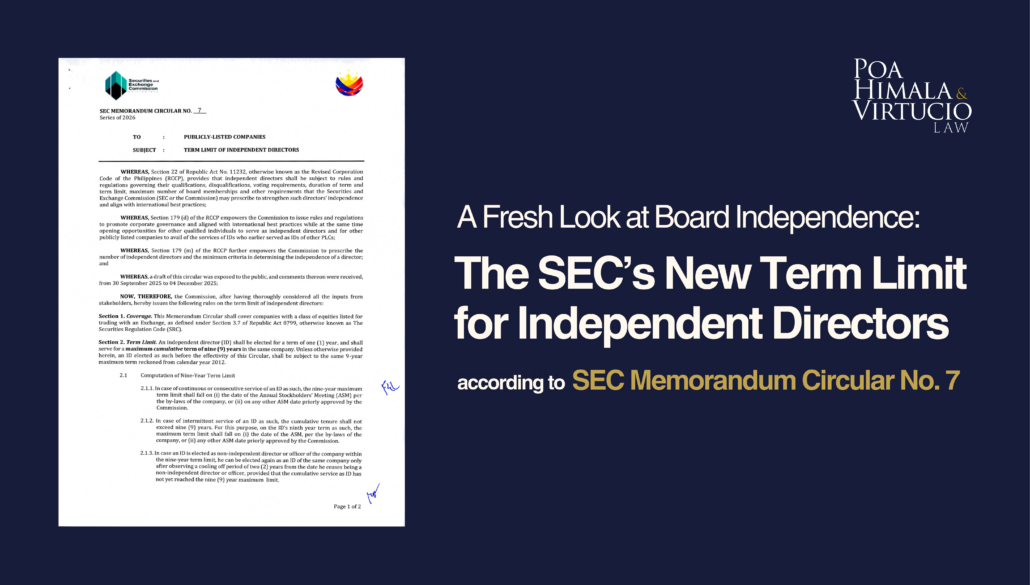
On 26 January 2026, the Securities and Exchange Commission (SEC) took a decisive step to protect that role. Under Memorandum Circular No. 7, an independent director is elected for a one-year term and may only serve for a maximum cumulative term of nine (9) years in the same publicly-listed company.
For years, Philippine corporate governance rules allowed independent directors to serve for extended periods—sometimes well beyond what governance experts consider ideal—subject to disclosures or exemptions. While continuity and experience have their value, the SEC has now taken the position that long tenure can quietly erode independence.
Put simply, the new rules aim to prevent boardroom entrenchment, encourage fresh perspectives, strengthen investor confidence, and align Philippine standards with global best practices.
Key Features of the New Rule
Effective 1 February 2026, the following shall be observed:
1. One-Year Term with a Nine-Year Cap
Under Memorandum Circular No. 7, an independent director is elected for a one-year term and may serve a maximum cumulative term of nine (9) years in the same company. This cumulative limit applies whether the service is continuous or intermittent.
2. Computation of Tenure
Any period of service exceeding six months is counted as a full year for purposes of computing the nine-year cap.
3. Lifetime Bar After Reaching the Limit
Once an independent director has served the maximum cumulative nine years, they are perpetually barred from re-election as an independent director of the same company. However, such individuals may serve as non-independent directors or officers of the same company without any cooling-off requirement.
4. Cooling-Off Period for Role Change
If an independent director transitions to a non-independent role or officer position within the nine-year period, they may be reappointed as an independent director only after a two-year cooling-off period, provided that the cumulative nine-year limit has not been breached.
5. Transitory Provision for Incumbents
Directors who have already reached the nine-year limit at the time the circular was issued may continue to serve only until the company’s 2026 annual stockholders’ meeting.
6. Penalties for Non-Compliance
Companies that exceed the term limit face a basic penalty of ₱1,000,000 per violation, plus ₱30,000 monthly fines for as long as the violation persists. Repeated offenses may lead to suspension or revocation of the company’s primary or secondary license, in addition to other sanctions under existing law.
Implications for Public Companies
The implementation of this rule, effective 1 February 2026 after publication in general circulation newspapers, compels publicly-listed companies to review and potentially reshuffle board compositions ahead of their 2026 annual meetings. Boards will need to ensure compliance by evaluating current independent directors’ tenure and planning for succession where necessary.
While governance advocates and analysts view the change as a positive step toward more objective oversight, some industry voices have previously suggested that rigid tenure caps could disrupt board continuity and institutional memory. Nonetheless, the SEC’s position is clear: fresh perspectives and independence are essential to sound corporate governance.
A Final Word
The SEC’s imposition of a strict nine-year term limit for independent directors represents a landmark enhancement of corporate governance norms in the Philippines. By establishing clear tenure boundaries, formalizing cooling-off requirements, and imposing significant penalties for non-compliance, the SEC aims to safeguard the integrity of independent directorship and ensure that boards remain effective, independent, and accountable.
MICHAEL T. POA
Managing Partner